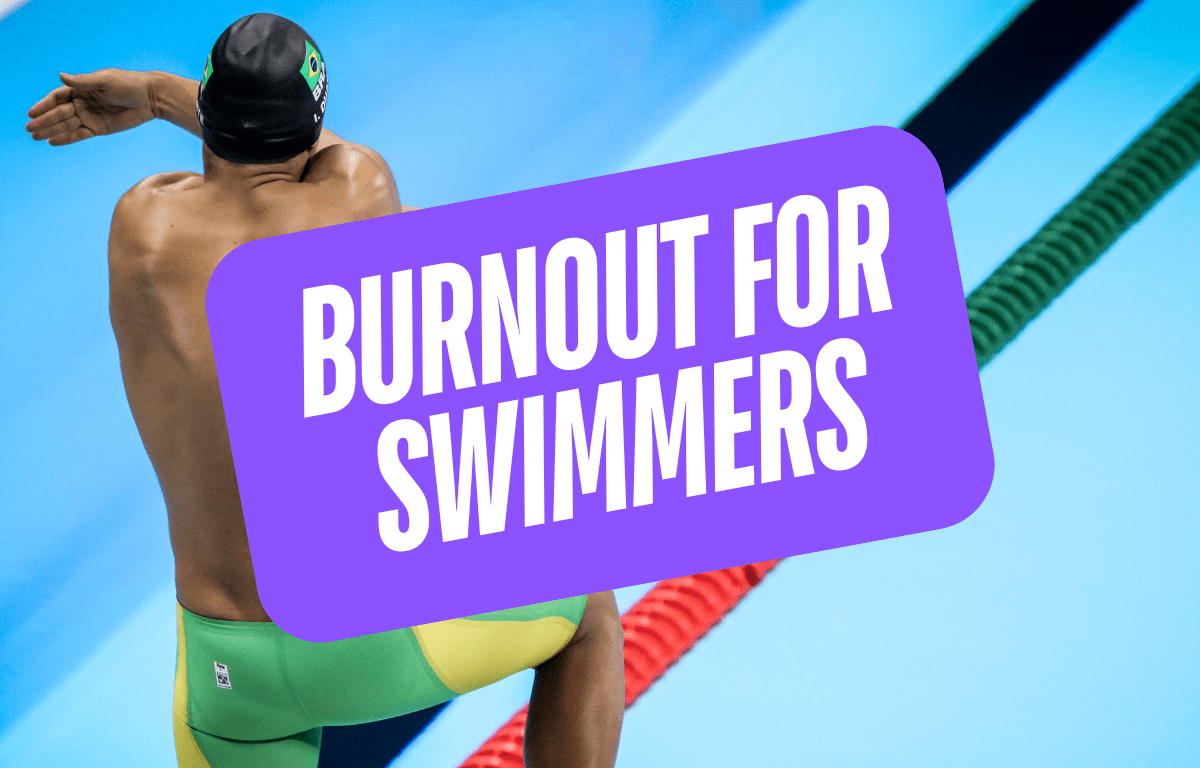

Burnout for swimmers starts long before you feel checked out. Learn what burnout is, what it looks like, how it impacts swimmers, and what swimmers can do to prevent it.
Burnout is a common—and misunderstood—problem in competitive swimming.
Swimmers who have gone through the process know that it doesn’t happen all at once. It builds quietly, stacking on physical and mental fatigue, building on dips in performance and confidence, and before long training is a complete grind.
The good news is that burnout is not inevitable—and it’s not permanent.
Understanding how it works can give swimmers (and coaches) an edge on navigating burnout before it happens.
In this guide, we will look at what burnout for swimmers looks like, why it happens, and discuss some proven strategies to prevent it from getting its claws into you mid-season so that you can get back to swimming fast and enjoying the process.
IN THIS ARTICLE
What is Burnout for Swimmers?
Burnout is a state of ongoing physical and mental exhaustion caused by prolonged stress. It shows up as slower swimming, lower motivation, and a growing loss of interest in the sport.
More specifically, burnout is a multidimensional system that develops when the demands of training and competition consistently outweigh the rewards. The hard work in the pool isn’t worth the results we are seeing.
In practice, burnout isn’t just about being tired or doing lots of hard work in training.
It’s a gradual shift in how swimmers feel, think, and perform. It starts with fatigue, progresses into frustration, disengagement, and for some swimmers, eventually leads to walking away from swimming altogether.
Signs of Burnout in Swimmers
Burnout isn’t always obvious. It shows up in patterns–how you feel in the water, how you think about your swimming, and how you respond to training.
According to Raedke’s (2001) foundational model on athlete burnout, the big signs for burnout to watch out for are:
- Emotional/physical exhaustion. Chronic fatigue beyond normal training tiredness. Swimmers have high RPE at normal speeds, take forever to get going in practice. “I’m cooked physically and mentally.”
- Reduced sense of accomplishment. Hitting times but feeling nothing, or like the work isn’t paying off, or feeling like things have plateaued. “I’m working hard and not improving.”
- Sport devaluation. The “I don’t care anymore” attitude, resentment toward practice and the sport. Skipping sets, mentally checking out, flirting with quitting the sport.
| Burnout Dimension | What it feels like | What it looks like |
| Emotional/physical exhaustion | “I’m cooked physically and mentally.” High RPE at normal speeds. Takes forever to get going in practice. | Dragging through warm-up. Struggling with sets that used to feel manageable. Needing more recovery between efforts than usual. |
| Reduced sense of accomplishment | “I’m working hard and not improving.” Hitting times but feeling nothing. The work doesn’t feel worth it. | Going through the motions. Indifferent to feedback. No investment in times or goal-setting. |
| Sport devaluation | “I don’t care anymore.” Resentment toward practice. Flirting with quitting. | Skipping sets. Mentally checking out mid-practice. Showing up because they have to, not because they want to. |
In a study with 181 competitive swimmers (Olsson et al., 2025), researchers measured burnout symptoms and compared those scores against competition times relative to the swimmers’ personal best times.
Sport devaluation—the “I don’t give a hoot” dimension—was the strongest predictor of underperforming on race day, explaining 12% of performance variance. Reduced sense of accomplishment showed a similar pattern.
Interestingly, physical exhaustion showed no significant relationship with times at all.
What does this mean? That swimmers can still show up to a swim meet and perform when on empty.
What really moves the burnout need is the psychological shift—losing belief that the hard work is paying off or not caring about the result entirely.
Why Burnout Happens in Swimmers
The feelings of burnout are pretty easy to feel—but what actually causes them? And why does it feel like burnout can suddenly pop out of nowhere?
Here are the most common causes of burnout for swimmers:
Burnout is rarely “too much training”
One of the big myths about burnout is that it revolves exclusively around training volume. But it’s much more subtle than that—it’s when costs exceed rewards over time.
In other words, swimmers work their tail off in the water, do all the right things in the gym and in the kitchen, but the times they see on the clock just don’t justify the work.
Two swimmers can do the same amount of training, one improves and the other burns out. The difference is psychological load, not physical load.
Research on competitive swimmers who quit the sport consistently cites failure to improve and training feeling too difficult as primary reasons for leaving (Monteiro et al., 2017)—both of which are symptoms of a reward deficit, not a lack of effort.
Hard training is delayed gratification. Hard training makes confidence go down and anxiety jump (Chortane et al., 2022). And hard training often yields slower swimming in the short term.
But when that hard work doesn’t come with improvement or anticipated results, the shadow of burnout starts to creep up on you.
Costs exceed rewards over time = Burnout
Burnout starts with physical fatigue
The first domino to fall when burnout happens with swimmers is fatigue. The sequence looks like this:
Fatigue builds > Performance drops > Confidence drops and anxiety increases > Motivation drops > Swimmer checks out
It doesn’t take much for training load and fatigue can impact our mindset.
A study (Aouani et al., 2024) compared fatigue and vigor between two groups of swimmers—one tapering, while the other continued high-volume training. The taper group saw fatigue drop 41% and vigor jump 43% in the same period.
The mental weight of training load is real, and it moves fast in both directions.
By the time swimmers get to the “check out” part of the burnout cycle, it rarely looks dramatic. Swimmers don’t usually quit in a big fireworks show mid-practice.
Instead, they quietly drift, with the most common reasons for dropout including “lack of fun,” “skills not improving,” and “having other things to do” (Monteiro et al., 2017).
That language sounds mild—but it’s often burnout’s final stage talking, not a genuine loss of interest.
Life stress impacts burnout
Burnout is often blamed on what’s happening between the lane lines and on the clock. But what’s happening outside of the water plays a big role, too.
A study with 453 athletes (Ma et al., 2025) showed that life stress had a significant impact on burnout.
Things like injury setbacks, performance demands, coach relationships, interpersonal issues, family expectations, and academics all piled up stress in the background.
This matters because stress drains the mental resources swimmers rely on to cope when things get tough.
Instead of responding effectively, athletes are more likely to fall into unhelpful patterns like rumination and catastrophizing—replaying mistakes, expecting the worst, and mentally spiraling.
Over time, those patterns are like adding fins and paddles to our stroke, accelerating us towards burnout.
Fatigue builds quietly but adds up fast
One of the hardest parts about dealing with burnout is that the “check engine” light often doesn’t turn on soon enough for coaches and swimmers to notice something is wrong.
Internal fatigue can accumulate quickly, even while times on the clock look normal.
For example, research on youth swimmers during a national championship meet found that even when times held relatively steady, internal fatigue markers told a different story—perceived exertion jumped over 50% and lactate nearly tripled (López-Hernández et al., 2025).
These were acute responses, but they were layered on top of multiple races and incomplete recovery, reflecting a growing accumulation of fatigue across the competition.
The body was under enormous stress that the scoreboard wasn’t reflecting. Swimmers can absorb a tremendous amount of training and competition load, but that resilience creates a blind spot.
The clock might say everything is fine, but it often lags behind what the swimmer is actually experiencing.
Fatigue comes from all angles
Swimmers tend to view fatigue primarily in terms of how their body feels. Tired arms, sore lats, twitchy calves after a big kick set.
But fatigue also takes place between your ears, and while it’s harder to sense compared to physical fatigue symptoms, it can have significant effects on how you swim, and by extension, its effects on burnout.
A study (Lima-Junior et al., 2025) with national-level swimmers did a 90-minute cognitive task to tire out the brain, and then had them do a 12×100 freestyle at lactate threshold followed by a 400 free time trial.
Compared against a control condition, mental fatigue caused a 3.9% performance crash in the 400m free trial—a drop of 11 seconds.
This was despite no significant difference in heart rate or lactate levels. RPE was much higher in the mental fatigue condition despite identical physiological load.
This is yet another reason of what makes burnout so challenging to troubleshoot. On the surface, everything looks fine. And fatigue wasn’t the result of more training and harder sets or not getting enough sleep.
Mental fatigue came in guns-a-blazin’ and forced swimmers to grind out a slower version of the same set.
Perfectionism leads to burnout
Setting high standards means you care about your swimming. Big goals, big effort.
But impossible standards are a trap—they create a situation where you never succeed and you respond to failure with harsh self-criticism, which leads to, you guessed it—increased risk of burnout.
A study (Fu et al., 2025) with 422 athletes found that higher perfectionism scores consistently predicted burnout six months later. The burnout athletes also hit all three burnout dimensions.
How this works is interesting: perfectionist swimmers (somewhat obviously) get frayed and burned out from the pressure of their own standards, but these high standards also isolate them.
Perfectionists tend to adopt a “lone wolf” mentality:
- Hide vulnerabilities
- Avoid help
- Inadvertently push teammates and coaches away.
That withdrawal leads to loneliness, which depletes the mental resources required to handle the demands of the sport.
We have all seen (or been) this swimmer: Goes a personal best time, still goes home feeling like it wasn’t good enough. The bar keeps moving. Satisfaction never shows up.
And over time that gap between performance and self-acceptance erodes the joy of the sport, inviting burnout.
Early specialization is a risk factor
Swimming is a tough sport in the water and on the calendar. The swim season starts in the fall, and at the higher levels, runs well into the late summer. That’s a lot of swimming—and specializing early compounds the load.
Year-round single sport training, and the lack of variety and constant competition exposure that comes with it, is linked to injury risk, psychosocial issues, and burnout/dropout (Wilczynska et al., 2022).
Another study, a meta-analysis of over 1,400 athletes, including swimmers, found that specializers scored higher on all three dimensions of burnout compared to multi-sport athletes (Giusti et al., 2020).
Swimmers who drop out are also more likely to have had fewer extra-curricular activities and less unstructured play during development—suggesting that variety early on isn’t a distraction from swimming, it’s a buffer against leaving it (Monteiro et al., 2017).
The coach relationship
The relationship with your coach is one of the leading predictors of burnout.
Across multiple studies, conflicts with coaches consistently rank among the top reasons that swimmers hang up their Speedos and quit (Monteiro et al., 2017).
When that relationship is rocky, it strips away the connection and purpose that makes brutal training worth doing in the first place.
How coaches interact with swimmers matters. A study (Choi et al., 2020) with 347 collegiate athletes found that when coaches gave autonomy—listening to input, explaining decisions, and respecting their perspective—burnout dropped.
On the flip side, more controlling styles—intimidation, conditional praise, shutting down athlete input—were strongly linked to higher burnout.
Better communication strengthens the coach-athlete relationship, and that relationship acts as a buffer against burnout over time.
How to Prevent and Manage Burnout
Burnout isn’t something that swimmers can push through and hope goes away on its own. That’s the path to checking out.
The better approach is to get proactive. Understand how it works and use proven strategies to manage and prevent it:
Catch burnout early
Burnout has a familiar pattern.
It starts with fatigue, leads to performance drops, and then the mental drops start happening, first confidence, increases in anxiety, and then drops in motivation.
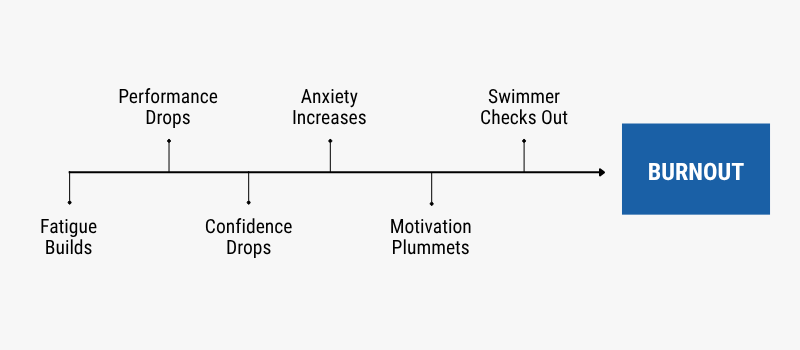
To prevent burnout, swimmers and coaches should pay more attention to the early parts of the sequence.
Burnout is typically only addressed when swimmers are at the tail end and motivation has already crashed and burned or they’ve fully checked out.
Pay attention to small changes: higher effort at normal speeds, slower recovery, or practices that feel much harder than they should.
That’s the window to adjust training, recovery, or stress—before it cascades further down the line.
Use the right mental skills
Mental training is one of the best ways that swimmers can handle and manage burnout symptoms.
A meta-analysis found that CBT-based techniques (goal setting, self-talk, reframing, visualization) produced moderate-to-large reductions in burnout symptoms in youth athletes (Wilczynska et al., 2022).
A study–this time with national level swimmers (Brat et al., 2025)–found that a structured mental skills program—combining goal setting, visualization, constructive feedback, and coach communication training—produced significant improvements in goal clarity, eagerness to learn, and overall motivational index over six months.
Swimmers who completed the program reported enhanced communication with their coaches and a more positive training environment, both of which are directly linked to burnout prevention.
- Goal setting. Unclear or unrealistic goals are a fast track to the “reduced sense of accomplishment” dimension of burnout. Learning how to set goals that are specific, process-focused, and within your control keeps training purposeful even when results plateau.
- Self-talk. The internal voice of the perfectionist swimmer can be brutal. Replacing self-critical thoughts with constructive self-talk directly counters the harsh self-evaluation cycle that drives perfectionism-related burnout. Even shifting from negative > neutral self-talk can kick burnout down the road.
- Visualization. Mental rehearsal builds confidence and reduces pre-competition anxiety without adding physical load. Using visualization to mentally prepare for races and hard training sets gives the mind a recovery tool that the body doesn’t have to pay for.
- Mindfulness — Chronic training stress narrows attention onto what’s going wrong. Practicing mindfulness to stay present during training reduces rumination between practices and after disappointing performances. Even just a couple of minutes of focused breathing per day can slash stress.
- Coach communication. Not a traditional mental skill, but the Brat study flagged it as a direct outcome of mental training. Communicating openly with your coach about workload, goals, and struggles reduces that isolating disconnection that accelerates burnout.
Know your emotional arc
Burnout is never born at the beginning of the season when you are inching our way back to peak shape. And no one experiences burnout when taper hits, volume decreases, and we get more rest.
It’s those heavy grinding blocks of training that test your mental and physical mettle.
You’re irritable outside of the pool. Motivation is harder to scrape together. You aren’t seeing improvement despite putting up record-breaking volume and intensity.
The thing is… this isn’t weird.
A study (Vacher et al., 2017) with elite swimmers followed their moods in the four months leading up to their national championship meet.
As training ramped up, anxiety, dejection and anger climbed with it. Happiness and excitement dropped in near-perfect opposition.
Then taper hit—and the emotional picture flipped.
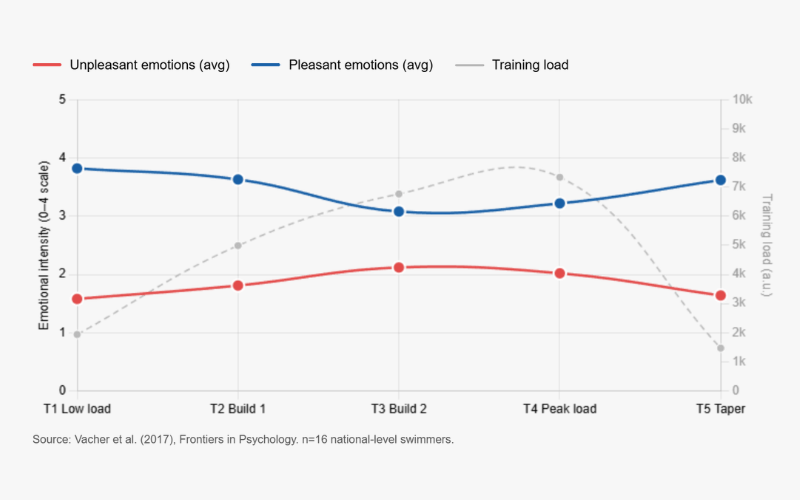
Hard training is hard—but it’s part of the process. It rarely means that you’ve lost your love for the sport and you’re headed for a breakdown.
You’re pushing your body, giving it all it can handle and more, and the drop in mood is your nervous system responding to an abnormal load.
Knowing that the arc of training leads to the feelings won’t necessarily make the “suffer” any less suffery, but will give you the mental backstop to know that it’s temporary.
Break the negative loop
Swimmers on the way to burnout often dive into unhelpful mental patterns like replaying bad sets (rumination), expecting the worst (catastrophizing), or blaming themselves for everything that goes wrong.
These thought loops quietly drain energy and make training feel way heavier than it actually is.
The fix is not to “think positive” or pretend like things are great when they clearly aren’t—it’s to think better.
Start with two simple upgrades:
- Positive reappraisal: Instead of “I’m off, this is a bad week,” shift to “This is a heavy phase of training—I’m building something.”
- Planning: Instead of spiraling on what went wrong, ask “What’s one thing I can adjust tomorrow?”
Research on athletes shows that more adaptive cognitive strategies like reappraisal and planning are linked with lower burnout, while patterns like rumination, self-blame, and catastrophizing are associated with higher burnout (Ma et al., 2025).
Breaking the loop gives you control over the one thing you can actually change right now—how you respond to what’s happening.
Swim-specific gratitude
One of the simplest ways swimmers can head off burnout is gratitude—the regular habit of outlining why you are grateful for the sport.
Sounds counter-intuitive—being grateful for long threshold sets, early mornings, soul-breaking main sets, and long swim meets—but there’s evidence to show that this works.
A 2021 study (Yukhymenko-Lescroart et al., 2021) analyzed 576 intercollegiate athletes and found that those reporting the highest sport-specific gratitude showed way lower burnout across every dimension measured—physical and emotional exhaustion, reduced sense of accomplishment, and sport devaluation.
The key to making this work is that gratitude was sport-specific.
General gratitude is great (“Grateful for nice weather, cable internet, and my dog!”), but it didn’t move the needle in the same way as shooting gratitude directly at your sport.
When you sit down with your training journal after practice, or after a big swim meet, quickly touch on something that you are grateful for in the water:
- Being able to train with your friends each day at the pool
- The opportunities to challenge and push yourself
- That your coach believes in you enough to ask you to do harder intervals
Small habit, big protective effort. And just a generally awesome outlook to have on life, too.
Targeted physical recovery
Burnout has a strong physical element to it. Mental skills are great and can be effective, but they can be overwhelmed by the sheer yardage of swim training. Which means smart recovery!
Recovery gets misused a lot—swimmers self-tapering or skipping workouts when the preceding work doesn’t justify it—so be honest with yourself about how you are using it.
The goal isn’t just feeling less physically tired but replenishing the mental resources that training and life stress steadily drain:
- Get more sleep. Increased sleep is the best recovery weapon swimmers have at their disposal (also the most enjoyable one). Chronic sleep deprivation—common in swimmers—causes plateaued swim times, persistent fatigue, and mood crashes. Fertile ground for burnout. Sleep more, swim faster and reduce the odds of burnout (Lundstrom et al., 2025).
- Periodize training. Swim training accumulates significant fatigue over the weeks and months. Periodic deloads (i.e. every 4th week train at 60-70% volume) and recovery-specific sessions in the water are essential for physical and mental recovery.
- Take real time away. Actual time away from the pool is a way to replenish your mental stores, releasing some of the pressure that can build up and lead to burnout. Easy practices don’t count. Fully clear the cache in your brain from swimming. Spend time with friends and family, go to the movies, read that book you’ve been itching to crack open—fully disconnect from the pool to protect motivation and fill up the tank.
Adam Peaty, Olympic champion and GOAT breaststroker, has a simple rule when he is at home—unplug and recover for real:
“At home we have a rule where we don’t talk about swimming at all,” Peaty notes. “Sometimes I go downstairs and my mum and dad are watching one of my races and I tell them to switch it off. If I start seeing that, I can’t stop thinking about it all night which means you are losing energy where you should be gaining energy.”
The Bottom Line
Burnout is sneaky and it doesn’t announce itself.
It builds quietly in the background, steadily gathering strength until it engulfs you during a random Wednesday night practice where your stroke is not clicking, you are off the pace, and your confidence is in the corner of the deep end of the pool.
But burnout isn’t inevitable, and it’s not permanent.
The swimmers who navigate it best aren’t immune to it—they’re just proactive about managing recovery, putting hard training into context, using the right mental skills, and knowing that perfectionism will tear their motivation apart if they let it.
The season is long, and the swimmers who thrive are the ones who take recovery and mental skills as seriously as the main sets.
Do the work to take care of yourself, and you’ll take care of the results on race day.