
Mental toughness improves performance, helps swimmers handle pressure, and even reduces burnout. Here’s a complete guide on mental toughness for swimmers.
Mental toughness and fast swimming go hand in hand like fins and paddles.
Swimmers who are mentally tough better persevere during adversity, learn from their mistakes, and better handle pressure.
Which leads to more potent swim workouts, faster results at swim meets, and podium finishes.
But what is it? How do we develop it? Mental toughness is often discussed in the abstract, something that just hangs in the air like the smell of chlorine.
The good news is that mental toughness is very much trainable.
In this guide, we’ll look at what mental toughness looks like in the pool, how it connects to performance, and what coaches and swimmers can do to develop it.
IN THIS ARTICLE
What is Mental Toughness?
Mental toughness is the ability to stay confident, focused, and determined while regulating emotions and behavior during challenging or high-pressure situations.
It’s a psychological resource that allows swimmers to maintain performance when things get hard—swimmers remain determined, focused, confident, and in control.
A simpler way to think about it is that mental toughness is what separates a swimmer who performs well consistently from a swimmer that only swims well when everything goes right. Tired, stressed, or under pressure, the mentally tough swimmer delivers.
Some athletes are more mentally tough naturally, partly due to genetics (Beattie et al., 2019). But studies with athletes—and swimmers in particular—show that mental toughness can also be increased and developed through training and experience (Gucciardi et al., 2015).
Mental toughness separates the swimmer who swim their best all the time from the swimmer who only swims their best when everything is “perfect.”
Why Mental Toughness Matters for Swimmers
Research consistently shows that mentally tougher swimmers outperform their peers. In one study, swimmers with higher mental toughness scores swam faster than those with lower scores (Guszkowska & Wójcik, 2021).
The researchers also found an interesting personality pattern. Swimmers who were more sensitive to punishment—meaning they respond strongly to negative feedback—and less sensitive to reward tended to display higher mental toughness.
These athletes also performed better in the water, and the relationship held regardless of age or gender.
Why does mental toughness produce these kinds of results?
Mentally tough swimmers experience the same challenges in training and competition as everyone else. The same ups and downs in training, injuries, races that don’t go according to plan. They just respond to them differently.
Setbacks are viewed as a springboard to more improvement (“How can I make this setback the best thing that’s ever happened to me?”).
They approach competition difficulties as challenges rather than threats. They’re more likely to use active coping strategies like self-talk, visualization, and attention control when things get hard.
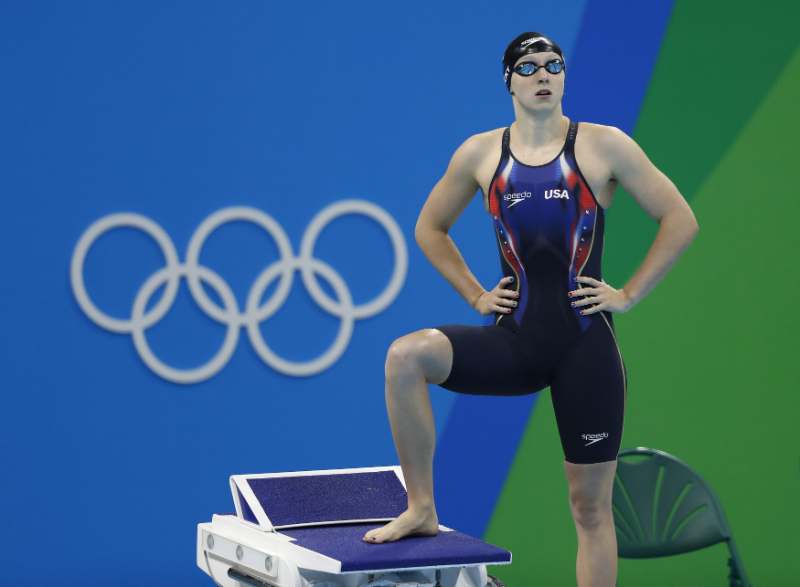
Mental toughness is also not limited to competition. Everyday training behaviors and habits also predicted mental toughness.
Self-regulated training behaviors—going to practice consistently, staying engaged through the workout, completing the sets as prescribed, challenging yourself in the main set—are strongly linked to mental toughness scores and, importantly, to how coaches rate athletes’ mental toughness behaviors in competition (Beattie et al., 2019).
In other words, how an athlete trains is a window into how mentally tough they are.
Mental Toughness and Fatigue
One of the clearest ways mental toughness shows up in swimming is how athletes deal with fatigue.
Swimmers often hear phrases like “your mind quits before your body does.” While it sounds like something printed on a motivational poster, research suggests there is truth behind the idea.
Fatigue is not simply the result of muscles running out of oxygen or energy. Increasingly, scientists understand fatigue as a brain-regulated signal designed to protect the body from excessive stress.
In other words, fatigue is partly a perception generated by the brain, not just a physical limitation.
This helps explain why two swimmers with similar physical ability can respond very differently during the same hard set. One backs off when discomfort rises. The other finds a way to keep pushing.
Research in endurance sports shows how powerful this perception can be.
In one study (Stone et al., 2012), competitive cyclists completed several time trials against a virtual avatar representing their previous best performance. When researchers secretly increased the avatar’s pace by 2%, the cyclists pushed harder and produced faster performances.
Swimmers often think they are operating at their maximum effort. But this is rarely the case—the brain regulates effort conservatively, holding something back to protect the body.
Mental toughness helps swimmers push closer to that reserve.
Instead of interpreting discomfort as a signal to stop, mentally tough swimmers learn to reinterpret fatigue as information—a sign that they are working at the edge of their capacity, not necessarily beyond it.
What Mental Toughness Looks Like in the Pool
When we think about mental toughness, most swimmers have a general idea of what it looks like—work hard, don’t give up, and thrive under pressure. And that’s a lot of it.
But a study with a group of elite American swim coaches provides a more detailed idea of what mental toughness actually looks like in the pool (Driska et al., 2012).
The coaches identified several key attributes, including:
- Unshakeable self-belief
- The ability to stay focused under pressure
- The drive to push into discomfort during hard sets
- Loving the pressure of competition
- The capacity to bounce back from bad races
Another attribute that is less obvious is coachability. Elite swimming coaches describe coachable athletes—ones who are receptive to feedback, communicate openly, trust the training—as distinctly mentally tough.
This isn’t blind compliance; it’s an athlete who has developed a genuine partnership with their coach built on earned trust.
Mental toughness isn’t just about getting mentally stronger, but also becoming mentally calmer. A study with athletes and non-athletes found that a mental toughness training program significantly reduced anxiety scores (Putra et al., 2025).
Another trait that shows up clearly in swimming is the ability to maintain psychological control on bad training days.
Mentally tough swimmers don’t need to fell perfect to get something out of practice. When they can’t hit their pace times, or their stroke feels off, or the intervals are beating them up, these swimmers find other ways to improve in the water.
- Focus on better streamlines.
- Clean body line in the stroke.
- Support teammates.
In other words, mental toughness means finding ways to keep progressing toward long-term goals—even when you aren’t swimming well that day. Mentally tough swimmers can always find something worth working on.
Types of Mental Toughness
Not every swimmer views and experiences mental toughness the same way. Swimmers can be mentally tough as a result of their goals, relationships, or emotions.
A 2026 study with elite swimmers (Kesler et al., 2026) found that they fell into three distinct mental toughness profiles:
The Goal-Driven Swimmer
The largest group of swimmers built their mental toughness around determination and problem-solving. For these athletes, being mentally tough meant refusing to quit and finding a way through obstacles.
Their defining mindset:
“When faced with challenges, instead of giving up, I strive to solve the problems.”
These swimmers tend to treat setbacks—bad practices, missed goals, injuries—as problems to solve rather than reasons to quit.
The Relationship-Driven Swimmer
Another group saw mental toughness as something that develops through the relationship between athlete and coach.
Feedback, communication, and trust were central. When they made mistakes, guidance from their coach helped them refocus and improve.
Their defining mindset:
“When I make a mistake, my coach’s feedback increases my focus, and I strive to improve my performance.”
The Emotionally-Driven Swimmer
A third group emphasized emotional control under pressure.
These swimmers described mental toughness as the ability to remain calm and composed in stressful moments such as big races or critical points in competition.
Interestingly, they were also more sensitive to how coaches evaluated them after mistakes, highlighting how emotional regulation and communication both influence mental toughness.
For coaches, this has practical implications: swimmers develop mental toughness through different pathways, and coaching strategies may need to adapt accordingly.
Fun Fact: Mental toughness can buffer against burnout. Swimmers work incredibly hard, and burnout is common. Collegiate athletes with stronger mental skills were significantly less likely to lose their sense of purpose or feel that their sport no longer mattered, even under heavy competitive pressure (Zhang & Yu, 2025).
How to Build Mental Toughness
Alrighty, let’s get to the good stuff—how to build authentic mental toughness in the pool that leads to better workouts and faster times on the clock on race day.
Use Mental Skills
Mentally tough swimmers don’t save their mental skills for big meets. They practice them deliberately and consistently alongside their pool training, giving them a strong foundation of mental toughness they can tap into when it matters most.
A study (Sheard & Golby, 2006) with national-level youth swimmers found that a seven-week mental skills program—45 minutes per week, using goal setting, visualization, and so on—showed improvement in 200m times. Swimmers also saw measurable gains in mental toughness, self-efficacy, and optimism.
- Goal setting – Swimmers who set goals connect daily training to long-term targets. A swimmer who knows why they’re doing a hard set is harder to break than one just surviving it.
- Self-talk – Self-talk is the voice in your head that tells you to keep pushing or to give up. Choosing self-talk that is positive or at least neutral naturally encourages more effort and resilience when things get hard.
- Visualization – Visualization is a way to normalize the feelings of pressure and to shore swimmers up against adversity under pressure. Imagine the start, the turns, the finish, the feel of swimming fast—and most importantly, yourself overcoming moments of adversity in competition.
Mental skills are criminally underused by swimmers, mainly because mental training carries a certain stigma or tracking improvement is much harder compared to logging improvements on the clock or in the weight room.
But mental skills are inseparable from mental toughness.
A study (Mleziva, 2014) with NCAA Division I swimmers found that a six-week mental skills training program—combining self-talk, goal setting, mental rehearsal, and thought stoppage—produced a statistically significant increase in mental toughness scores.
Work strengths and weaknesses
When working to improve mental toughness, swimmers will work hard on the skills and areas where they are already strong, but then lose interest when it comes to working on their mental weaknesses.
For example, a mental skills intervention with elite college swimmers completing found that compliance was great early on when it focused on capitalizing on strengths.
But once the training shifted to confronting weaknesses, effort dropped off. Journal entries tapered, daily tasks went unfinished, and some athletes disengaged completely.
This matters because it reveals something true about mental toughness training that most programs don’t acknowledge: the part that actually builds resilience is usually the part athletes are most reluctant to do.
Working on your strengths feels productive. Working on your weaknesses feels uncomfortable.
Don’t avoid the work just because it feels struggley. Just like in the water, improving mental toughness means working on the things where you stand to improve the most.
Train your perception of failure
Elite swimming coaches describe workouts designed to induce failure—hard intervals, technical standards that swimmers can’t always hit—as essential for mental toughness development.
The key is timing and intentionality.
Early in the training year, build confidence. Introduce failure sets progressively as the season develops. Revisiting those sets later lets swimmers experience and demonstrate growth (Driska et al., 2012).
One elite swim coach’s principle requires swimmers to purposely walk the line between success and failure in training:
“If your kids are succeeding at 100 percent in practice all the time, motivation goes low. They’ve got to fail sometimes. That’s what keeps them coming back.”
Journal it out
Swimmers can develop stronger mental toughness by logging their swim practices in a training journal. Countless Olympic champions have used this simple tool for better swimming, from Janet Evans to Katie Ledecky to Caeleb Dressel.
The logbook can be used to help bounce back after a bad workout or disappointing swim meet. Write down how you did, objectively assess it, and move on.
Olympic, World, and NCAA champion Caeleb Dressel has been writing out his workouts in a logbook since he was an age grouper. And one of the perks? The logbook is a way to move on from a bad workouts.
“If I have a bad practice, it’s hard for me to unwind from that,” said Dressel. “I don’t like having bad practices, it makes me anxious…. I will lose some sleep at night. Once I put pen to paper… it almost helps me get rid of it, whether it’s good or bad.”
The key is to avoid ruminating over and over on setbacks and bad swims. Write it out, quickly analyze it for feedback, and “flush it” so that you can get back on the horse tomorrow.
Learn from your failures
Mentally tough swimmers don’t respond to failure by gritting their teeth and going again—they stop and listen to what the failure is trying to tell them.
When things don’t go your way, there’s always a lesson. Maybe you need to spend more time on your underwaters. Improve strength in the gym. Tighten up your stroke timing.
Hard work and persistence are a huge part of the puzzle (obviously)—but learning from your setbacks and failures is what drives elite mental toughness.
A study (Yin et al., 2019) at Northwestern University analyzed over 700,000 grant applications over a 30-year stretch and found that persistence alone didn’t predict success. Those who failed and those who succeeded made the same number of attempts.
Those who eventually broke through retained what worked, fixed what didn’t, and made targeted adjustments. Those who stagnated changed things at random—there was no real feedback loop, no pattern of improvement. Same number of failures.
In other words, success was made possible by listening to what failure was trying to say.
At the 1988 US Olympic Trials, Summer Sanders led the 200m individual medley for the first 150m of the race, only to fade and finish outside of the Olympic team qualifying spots.
She read the performance as data.
She knew exactly what to work on, and four years later at the 1992 Barcelona Olympics she won two golds and a bronze.
“Failure just showed me what exactly I had to work on—my stroke, my dive, my turns. If I did the work, I had nothing to fear.” – Summer Sanders
That’s what mental toughness looks like applied to failure. It’s not fearlessness, but the ability to stay clear-headed enough to hear what a setback is trying to tell you.
No such thing as a “bad” practice
Mentally tough swimmers make the most of the opportunities they in the water to improve.
That means when a bad swim workout happens, and they certainly will over the course of a training block or season, the mentally tough swimmer finds a way to salvage it for improvement.
Teaching swimmers to find something productive when they’re off—a technique cue, an attitude standard, a way to support a teammate—builds your ability to be tough under adversity, which is wildly important for competition.

Mentally tough swimmers remain functional under adversity, and this ability can be fine tuned simply by productively responding to the moments where our stroke and pace are off in training.
Caeleb Dressel, when having a bad workout, brings his focus back to technique, knowing that form is an on-ramp back to better swimming:
“If I’m doing super bad that day, I can at any point do five kicks off every wall freestyle and then work on the breakout,” said Dressel. “And how hard can it be to focus on the correct catch, not slipping my arm to the outside.”
Bad practices happen to everyone in the pool on occasion.
The mentally tough swimmer is the one who can find a way to make it productive and develop something.
“I try to make the good days great and take something positive from the days I’m not feeling good—work on technique or something like that.” – Katie Ledecky
Develop the Coach-Athlete Relationship
Mental toughness doesn’t develop in isolation from the coach. Coachable swimmers who communicate openly with their coach, trust the program, and feel genuinely heard show more mental toughness attributes (Driska et al., 2012).
Coaches who provide timely, learning-focused feedback—especially after mistakes—support mental toughness development in the swimmers who respond most strongly to relational dynamics (Kesler et al., 2026).
This means for coaches: if you want mentally tough swimmers, invest in communication.
Explain the purpose of sets. Have the hard conversations. Give swimmers opportunities to fail forward. Make your athletes feel like partners in the process, not just subjects of it.
The Bottom Line
Mental toughness is a trait that can be hard to pin down, especially when some swimmers really just “have it,” while others need to shape and hone it in training over weeks and months.
But it’s a very trainable capacity that predicts performance across every level of competitive swimming, from age groupers to elite national team members.
Use the right mental skills. Work them. Reframe failures and setbacks. Build a good rapport with your coach that supports mental toughness. Find something useful from the bad days.
And remember that you’re tougher than you think, and faster than you know.
This guide to mental toughness for swimmers is part of our series on mental training for competitive swimmers. Read more articles and resources below.