
Faster flip turns are one of the quickest ways to improve times in the pool. Here are seven tips to get in and out of the turns faster.
In the race to get better and faster we are always looking at doing more.
More training at race pace. More sessions in the water. More high tech space fabric for our swimsuits. More large pizzas after practice.
What?
But, as you will see in a little bit, you can produce faster swimming and do a flip turn more efficiently to get better results in the pool with only having to give a little more mental focus while training in the pool.
After all, when you watch your local swimmers go through the motions during their workouts, most of their flip turns are slow, unfocused, and rob them of the speed and velocity that they worked so hard to build up over the course of each length.
Let’s get our flip turns on.
How to Improve Your Flip Turns
- Line up the turn with the “T”
- Accelerate into the wall
- Don’t breathe into the turn
- Balance power and wall contact time
- Build your core
- Align your body
- Get more sleep
Why Faster Flip Turns Matter: A study of elite 1500m freestyle World Championship finalists found that turn performance was just as strongly related to final race ranking as swimming speed between the walls (Polach et al., 2021). In other words, turns influenced race outcomes as much as surface swimming speed.
1. Line up the turn with the “T”
Swimmers have a love-hate relationship with the black line at the bottom of the pool. It’s often our only companion during those long swim workouts.
But it also keeps us from veering absent-mindedly into the other side of the lane (into oncoming swimmers) and with the help of the tiled “T” at the end of each length, helps us line up our turn.
Timing the T takes a lot of practice, and even the greatest swimmer in history, Michael Phelps isn’t immune to the occasional “oopsie” when it comes to hitting the turn properly. At US Nationals in the summer of 2014, Phelps missed the wall in the 100m freestyle.
This means:
- Squaring up with flat shoulders
- Not listing to the side during the tumble
- Swimming “straight” at the T
Fast flip turns start with moving and initiating the turn efficiently. Use the “T” as your guide to do so.
Get comfortable swimming into the wall at different speeds–swimming fast, swimming slow, swimming fast with fins–it will improve your ability to properly judge when to commence your flip turn.
2. Accelerate into the wall.
Approach velocity is one of the strongest characteristics of a fast flip turn. Studies with elite and national-level swimmers (Puel et al., 2023; David et al., 2022) show strong correlations between how fast swimmers approach the wall and how quickly they turn and push-off.
The speed you carry into the turn directly feeds the speed you carry out of it into your streamline and underwaters.
The challenge is that slowing down as the turn approaches is completely natural–there is an unforgiving and unmovable wall coming your way, after all. Your brain also is judging distance, so you lift your head, “snow plow” the water, and subtly bleed off speed.
“Don’t slow down, swim fast, and the turn will be fast… I always tried to keep my speed up through the entire swim and especially the turn.” — Tom Jager, 2-time Olympic gold medalist
Recently I detailed an old swim of mine where I visibly and measurably slowed down in the 10m leading into the one turn of a 50m freestyle. The cost? 0.6 seconds–basically a lifetime in a 50.
Instead of going through the motions and surviving the turn, think about attacking it. The more speed you carry in, the faster the tumble turn rotation, the faster you will push off.
As Russell Mark, a high-performance consultant for ASCA (and formerly USA Swimming) notes:
“Besides the start, pushing off the wall is the fastest a swimmer will go during a race.”
Carrying more speed into the turn is win-win–turn speed goes up, push-off velocity goes up, and swimming times go down.
3. Don’t breathe into the turn
Your coach has told you repeatedly the importance of not breathing into the wall. Here’s why they are right.
When you turn your head to breathe at the last stroke before the wall, your head rotates to the side to grab air, disrupting body alignment, slowing you down, and causing you to begin the turn rotation closer to the wall than you should.
A study (Faelli et al., 2021) measured what happens when swimmers breathe vs don’t breathe during the last stroke before a flip turn.
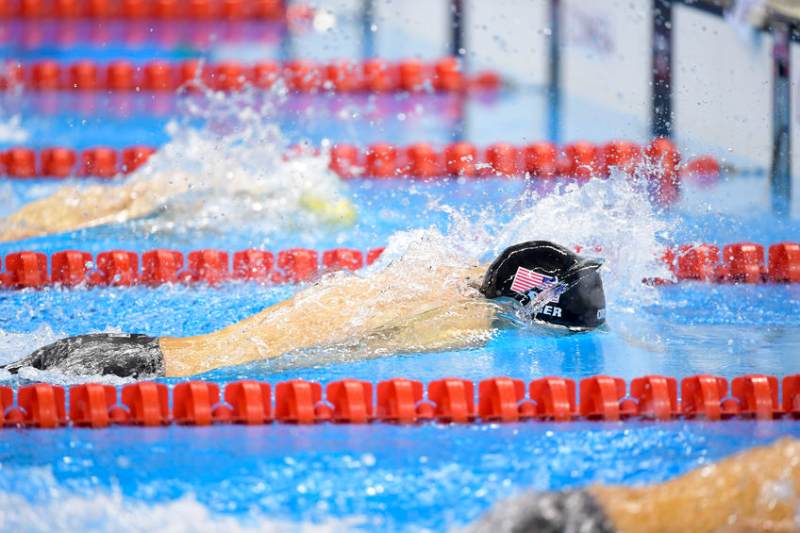
When swimmers didn’t take a breath right before the turn:
- Approached the wall faster
- Initiated the turn further away from the wall
- Rotated quicker
- Pushed off with more speed
- And perhaps surprisingly, glided further underwater
The main reason that the “no breath” flip turn works is because you better maintain body alignment going into the turn.
By not breathing into the turn, the head, shoulders, hips, and feet are better lined up in an optimal position to rotate fast and transfer force efficiently.
When we swing our head to the side to breathe, your body is already fighting that misalignment heading into the turn and push off.
At practice today, start by not breathing into the turn during easy swimming (warm-up, drills, warm-down, etc) and steadily extend that breath discipline to the main set. It will feel uncomfortable at first, but the flip turn speed and faster results on the clock are worth it.
4. Balance power and wall contact time
Swimmers tend to think that fast turns means really short wall contact time. Soon as their feet touch the wall, they push-off like it’s lava. While this makes sense, it’s also important to balance force development so that you can push-off with lots of speed into your streamline.
Push-off force–how much of it you can generate after you’ve tumbled–is a massive determinant of flip turn speed. One study (Araujo et al., 2010) with national and international-level swimmers found that it contributed to 42% of the variation in turn time!
Generating that power means giving yourself sufficient time to do so.
Research with Dutch national-level swimmers found that a slightly longer wall contact time allowed swimmers to build greater peak force at the moment of push-off, when the body was already in a streamlined position (David et al., 2022). That timing matters:
- Short wall contact time means insufficient power
- Too long wall contact means added time on the clock for no added power
Think of your push-off like a squat jump off the wall—you need to load before you can explode.
Additional analysis found that faster elite sprinters had shorter contact and push-off times overall, but they applied force earlier and more efficiently within that window (Puel et al., 2012).
Fast flip turns mean that you are minimizing wasted time on the wall while maximizing the force you generate.
Snappy contact time, powerful, well-timed push.
5. Build your core for faster turns
The flip turn is initiated by the arm pull, and your legs go flying into the air and plant the wall for the push-off, but your core is at the center of it all.
It controls body position during rotation, keeps you tight through the tuck, exerts force through the limbs, and maintains that sleek, streamlined body alignment you need to push-off fast.
A six-week dryland core training program with national-level swimmers produced measurable improvements in push-off speed—shaving a tenth of a second on their turns (Karpinski et al., 2020). That sounds small, but in a short course race with multiple turns, this kind of improvement compounds rapidly.
The connection between the core and more efficient flip turns makes sense when we think about what goes into a good turn:
- Controlled tuck
- Aligned push-off
- Accelerating and decelerating rotation
- Creating a streamlined upper body for the push-off
- Pointing the body and arms in a horizontal position
When the core is strong and provides stability, swimmers move through the turn with speed and control.
Planks, Swiss ball tucks, hollow body holds—nothing crazy. Add them to your dryland and your turns will become a weapon.
6. Rotate at the right distance
Most flip turn tips and pointers are about what happens at the wall. Push, tuck, rotate, streamline, and boom–fast underwaters. But before we get to all that good stuff, there is the important detail of initiating the rotation at the right distance.
- Too early, and you are pushing off with your tippy toes, generating almost no force
- Too late, and you are stuck in the hole, taking forever to generate enough power to get out
Research with national-level swimmers showed that the distance between your hips and the wall at the moment your feet plant–what is called “Tuck Index” in the research literature–has a huge impact on push-off force and exit velocity (David et al., 2022).
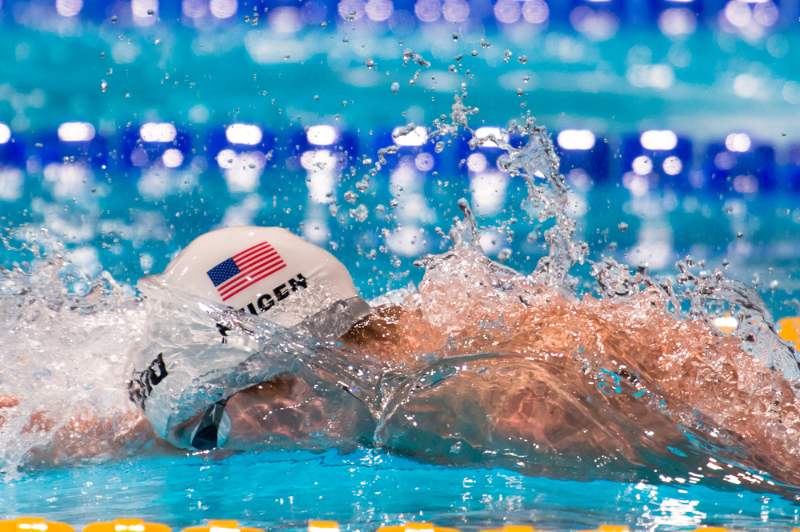
The sweet spot is a 90-degree knee angle when your feet hit the wall. From there, your legs have the winning combination of range of motion and the muscle tension needed to explode off the wall with maximum force.
Experiment with timing the turn in practice. If your turns consistently feel weak off the wall, or like you are doing a deep squat each time you turn, adjust when you initiate the turn until the push-off feels loaded and fast.
6. Stay tight and aligned
The rotation of the flip turn is where swimmers often lose a lot of speed. There are several reasons for this.
Swimmers will:
- Pick up their head. Lifting your head to sight the wall before rotating exaggerates your turn radius and sends you up and over instead of straight through. You pay for it twice—once on the way in with wasted distance, and again on the way out when you have to over-compensate for the added rotation, which usually leaves you pointing at the surface instead of down the lane. Keep your head neutral and trust your stroke count to the flags.
- Lead the turn with the heels. As you begin to rotate, you need to bring your feet up and around your body. But instead of thinking about where your feet are, focus on driving the thighs into your stomach as your waist bends. When we turn with the heels, the knees tend to bend too early and create unnecessary drag. By focusing on waist fold, the rotation stays compact and the feet get to the wall naturally.
- Fumble with the arms. The arms should organized into a tight streamline when their feet hit the wall. Instead of touching the wall with the feet and then getting into a streamline, be ready to go. This reduces unnecessary wall contact time and keeps the body aligned and ready for launch.
A tight, efficient rotation is the bridge between a fast approach and a powerful push-off. Straight in, straight out.
7. Get more sleep.
The most enjoyable way to improve your flip turns has nothing to do with technique. It has to do with how much sleep swimmers get.
Researchers at Stanford instructed swimmers to extend their sleep by one to two hours per night over six weeks. Performance improved across the board–reaction times, sprint speed, and turn speed all got faster. On average, swimmers dropped 0.10 seconds off their turns just from sleeping more.
A tenth of a second per turn, across a short course race, across an entire season accumulated training quality–that turns (ha) into something really significant.
Faster turns, faster swimming, and more sleep? There are worse training plans!
The Next Step
Swimmers perform a dizzying amount of flip turns over the course of each week during practice.
How many of them are done at your best? How many of them are performed mindfully and with focus?
Don’t wait for your coach to put on a specialized “starts and turns” session—although who doesn’t like themselves one of those?—and take the lead on leveling up your flip turns the next time you walk out on deck.
After all…
If you put even just a couple of these tips into place you will drop some significant times on your flip turns, which will translate into faster times where it matters most—the clock.
More Stuff Like This:
Pro Tip: How to Double the Number of Turns You Do In Practice. Want more work on your flip turns? Here is a way to increase the overall number of opportunities to level up your walls.